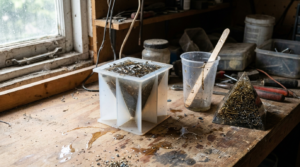
How to Use Orgonite Moulds: Pouring, Demoulding and Making Them Last
The Reality of Pouring Orgonite So, you have your mould sitting on the workbench and you are ready…

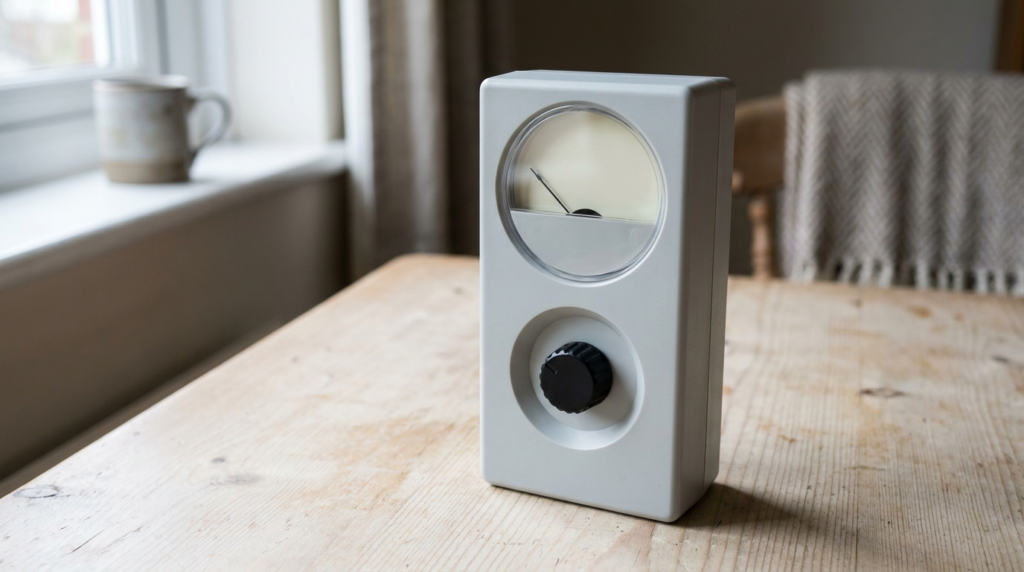
I’ve lost count of how many times I’ve watched someone switch on a meter near a router, watch the display jump, and panic. The temptation is to treat that number as a final verdict.
Let us have a look at what the TriField EMF Meter TF2 is actually telling us, and just as importantly, what it is not.
The TF2 is designed as three instruments in one. It measures AC magnetic fields, AC electric fields, and radio frequencies. Selecting the mode is not a minor setting. It determines which sensor is active and which units are being displayed.
A field reading simply shows that energy is present within that specific frequency range. It does not automatically identify the source. That makes our baseline-first EMF guide a useful companion here.
We identify sources by moving the meter and changing one thing at a time, rather than pointing it at a wall and declaring victory.
When we turn the selector to magnetic mode, the TF2 is working as an AC gaussmeter. It reads the alternating magnetic field in milligauss (mG), covering a frequency range of 40 Hz to 100 kHz. This is where you will find the ordinary power-frequency environment around household wiring, refrigerators, circuit breaker boxes, and transformers.
The electric mode measures a different aspect of that same low-frequency environment. Here, the meter acts as an AC electric-field sensor, expressing its result in volts per metre (V/m). A powered cable can create a strong electric field around it even when no current is flowing.
Electric-field readings are incredibly sensitive to your setup. Your body, the floor, and whether you are grounded all change what the sensor sees. I always recommend holding the instrument consistently. Do not lean it against a wall or rest it on a conductive surface unless that is the specific condition you are testing.
This is the mode most of us use when tracking down modern Electrosmog. The RF setting changes the sensor to read radio and microwave power density, measured in milliwatts per square metre (mW/m²). The frequency range here spans from 20 MHz to 6 GHz.
Mobile phones, cell towers, smart meters, and Wi-Fi routers live in this band. Of course, these devices do not transmit continuously. They pulse, upload, and search for service in bursts. The TF2 includes a Peak Hold function specifically to capture these fast digital pulses, holding the highest value on the screen.
A changing display is usually telling us something real about the network’s activity. It is not just misbehaving for sport. Take several observations over time, and remember that an RF meter cannot decode a network name or single out one transmitter from a cluster. It simply shows the total power density hitting the sensor in that moment.
Put an EMF meter next to a cell phone mast and then put a piece of orgonite beside it. The meter will beep just as loudly. The radio frequencies are still there.
In my opinion, orgonite works on the deadly etheric component — the DOR that those fields generate — and not on the radio waves themselves.
Let us clarify the history here. According to Dr. Wilhelm Reich, who discovered orgone energy, this universal life force exists in different states. POR (Positive Orgone Energy) is the state of free, unhindered flux. DOR (Deadly Orgone Radiation) is the state where this energy is dammed up, stagnating, and associated with decay.
In our experience, the dense electromagnetic fog of modern wireless technology creates a massive DOR problem. Reich built devices to accumulate ambient orgone, most famously the Orgone Accumulator (ORAC).
His original Cloudbuster — a bundle of pipes grounded into a water body through a cable — moved stagnating DOR in the atmosphere. But these devices struggled in heavily DOR-polluted environments because they could not generate new POR.
Karl Hans Welz solved this when he invented orgonite. He discovered that a simple compound mixture of resin and metal filings actively transforms stagnant DOR back into flowing POR.
Don Croft later added quartz crystals to this matrix and sparked the worldwide gifting movement, creating the Tower Buster (TB), the Holy Handgrenade (HHG), and his own Chembuster, which operates on entirely different principles to Reich’s original device.
The piezoelectric effect is real and well documented in engineering. I sympathise with anyone reaching for it — after all these years I would love a tidy conventional answer too.
But the squeeze a crystal gets while resin cures is a one-off event, and it is finished the moment the resin has set. It cannot be the continuing mechanism for how orgonite works.
We do not need a laboratory-verified mechanism to see the results. We simply observe the plants growing better, the birds returning, and the atmosphere clearing after a gifting run. The physical RF measured by the TriField meter remains unchanged, but the etheric environment is transformed.
Specifications are most useful when we treat them as boundaries. They tell us exactly what the instrument is built to handle. The documented ranges for the three modes look like this:
| Mode | Frequency range | Stated measurement range | Unit |
|---|---|---|---|
| AC magnetic | 40 Hz to 100 kHz | 0.1 to 100.0 | mG |
| AC electric | 40 Hz to 100 kHz | 1 to 1000 | V/m |
| RF | 20 MHz to 6 GHz | 0.001 to 19.999 | mW/m² |
This table is a compact reference. A value in mG answers a completely different question from one in V/m or mW/m². If a signal falls outside these frequency bands, the meter will not represent it accurately. And when the screen reaches the top of its range, it has not measured an infinite field. It has simply hit its ceiling.
The best reading is the one we can explain and repeat. You do not need a laboratory coat, though a notebook is surprisingly effective. I like a simple method: choose the mode, establish a background baseline, and walk the space.
Before you approach a suspected source, take a reading in a quieter part of the room. This gives you a local reference. Then move closer in consistent steps. Check the source from a few different angles.
Record the distance, the mode, the unit, and whether the equipment was actually running. If you are tracking RF from a local mast, note the time of day, as network traffic fluctuates. Afterwards, you can compare the pattern instead of relying on one memorable spike on the screen.
This is the same method we use on our own expeditions — a baseline before we place anything, then a return visit to compare the pattern, not a single reading treated as proof of anything.
No. They are related parts of electromagnetism, but they are different quantities measured in different units. A reading in volts per metre cannot be directly compared with one in milligauss.
Fields vary sharply with distance, orientation, nearby materials, and your own body position. Wireless signals also change constantly because transmitters do not operate at a single continuous level.
Not by itself. A reading shows that the sensor is responding to energy in that spot. Identifying the actual source requires controlled changes, like switching devices off, or simply tracking the field strength as you walk.
Mostly. The RF mode covers 20 MHz to 6 GHz, which catches the low-band and mid-band 5G that most networks actually use. The higher millimetre-wave 5G bands, which run well above 6 GHz and have a much shorter range, fall outside what the TF2 can read.
We use meters to map the physical electromagnetic fields around us, and we use orgonite to handle the stagnant DOR those fields create. If you want to explore this for yourself, you can shop practical orgonite straight from our workshop. Just remember to keep your conventional field readings and your energetic observations as two different, equally fascinating conversations.

Ready to experience orgonite for yourself?
Shop All Products → The Reality of Pouring Orgonite So, you have your mould sitting on the workbench and you are ready…
The Sticker Shock: Why do prices vary so wildly? If you have been looking for a Cloudbuster online,…

Why measure EMF at all? I remember the first time I got my hands on a decent EMF…
Georg's expedition reports, orgonite guides and community news — straight to your inbox.
Unsubscribe anytime.