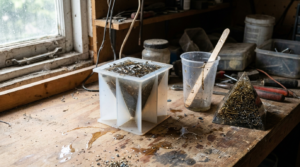
How to Use Orgonite Moulds: Pouring, Demoulding and Making Them Last
The Reality of Pouring Orgonite So, you have your mould sitting on the workbench and you are ready…

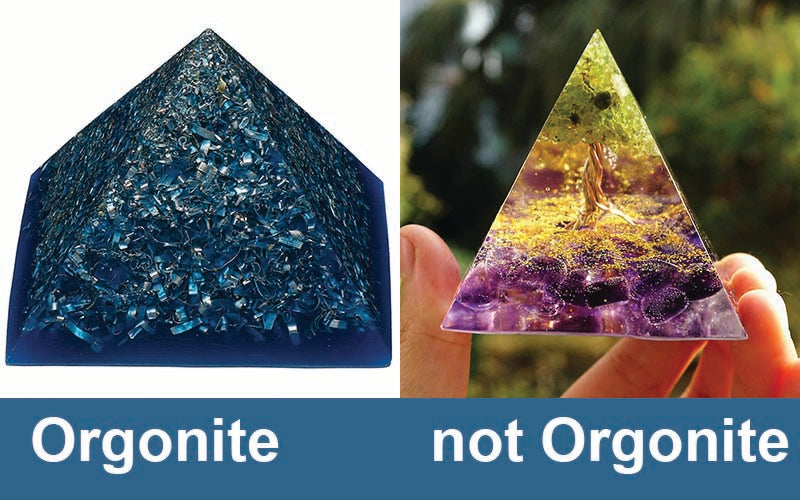
A few years ago, I saw a striking clear pyramid described as orgonite. It had one copper spiral, a crystal in the centre, and almost no visible metal elsewhere. It was attractive, certainly. But the label was doing more work than the material.
When we look for real orgonite, we have to start with the physical object. A good buying decision separates the actual materials from the grand promises attached to them.
Let us first clarify where this all comes from. Dr. Wilhelm Reich discovered orgone energy, noting it exists in two basic states. POR or Positive Orgone eneRgy is the healthy, life-affirming state of free flux. DOR or Deadly Orgone EneRgy is the stagnant, toxic state where this energy is dammed up.
Reich built the Orgone Accumulator (ORAC) and the original Cloudbuster, which used pipes grounded into water to draw DOR from the atmosphere. But Reich did not invent orgonite.
That was Karl Hans Welz. He discovered that a simple matrix of curing resin and metal filings could actively transform DOR into POR.
Don Croft later added quartz crystals to this mix and started the worldwide gifting movement. We owe a great deal to this practical approach. Croft’s additions gave us the familiar Towerbuster (TB) for gifting cell towers, the Holy Handgrenade (HHG), and the Chembuster.
Just to make this clear: the Chembuster is an orgonite-based device. It is not to be confused with Reich’s original water-grounded Cloudbuster.
So, a real piece of orgonite is primarily that original matrix: resin and metal. Crystals are a wonderful addition. But they are not what makes the casting orgonite in the first place.
The familiar physical idea is a matrix of resin and metal shavings. The resin forms the organic component, while the metal gives the casting its visible density and irregular internal structure.
The practical question is therefore not whether a piece contains a dramatic quartz point. We should ask whether there is enough metal throughout the resin to make the description meaningful.
A useful orgonite composition guide makes this same distinction between the core matrix and decorative additions.
At Orgonise Africa, our pyramids are made to a 50/50 metal-to-resin ratio. That is a construction standard you can actually look for, and it is the same standard the wider DIY community uses to separate field-grade orgonite from decorative resin art. In my experience, this dense, chaotic matrix is what creates the transformation from DOR to POR.
One customer who has bought from us for years summed up the difference plainly: “I love the quality of their orgonite, it’s hard to find high quality 50/50 metal/resin ratio with crystals inside the way these guys make it. They make the power houses of orgonite!” That is the standard worth holding any seller to, ourselves included.
Words such as “high vibration” or “advanced” may express a maker’s intended use, but they are not a materials specification. We should also be wary of explanations that borrow scientific vocabulary without explaining a testable process.
The piezoelectric effect is real and well documented in engineering. I sympathise with anyone reaching for it — after all these years I would love a tidy conventional answer too.
But the squeeze a crystal gets while resin cures is a one-off event, and it is finished the moment the resin has set. It cannot be the continuing mechanism.
The same is true for theories relying on scalar waves, quantum physics, or negative ions. The piezoelectric myth is worth reading before we treat that explanation as established fact.
In my opinion, orgonite works purely on the etheric level. It transforms stagnant DOR into flowing POR. We do not need to force it into a laboratory framework for it to be effective in our daily lives.
This is a question we hear constantly. Put an EMF meter next to a communication mast, and then put a piece of orgonite beside it. The meter will beep just as loudly.
The radio frequencies are still there. Orgonite does not shield or neutralise the physical radio wave.
In my opinion, orgonite works on the deadly etheric component — the DOR that those electromagnetic fields generate — and not on the radio waves themselves.
The density of modern communication towers creates a serious DOR problem. That stagnant energy is what we call Electrosmog. Orgonite simply transforms the stagnant energetic environment back into a healthy, breathing POR field.
Product photography is not a crime, although it occasionally behaves like an accomplice. Polished clear resin and a dark background can make a sparse piece appear much richer than it is.
We are looking for a dense matrix, not merely sparkle. Dense shavings create overlapping curls and fragments that interrupt the resin from one side to the other. Sparse fillings often sit in a little cluster around a crystal.
Look for clear views of the sides, base, and interior. If every photograph is taken from the exact same front angle, we cannot tell whether the metal continues through the object. A front face with a central crystal may reveal almost nothing about the back.
The base deserves particular attention. Sellers sometimes photograph only the polished front. If the underside is missing from the listing, we should ask for a view before deciding the interior is dense.
Do not confuse large individual pieces of metal with greater metal content. A few chunky fragments may look impressive while occupying far less overall volume than a bed of fine shavings. The eye needs to judge the whole casting.
We can use a simple sequence when comparing images. Inspect the front, rotate to the sides, find the base, then compare the visible matrix with the written description. This turns browsing into a small investigation rather than a contest between attractive thumbnails.
Price is a poor substitute for inspection. An expensive piece may earn its price through meticulous polishing, a complex shape, or hours of labour.
That is perfectly fine if you want a beautiful handmade object. We can appreciate the craftsmanship. It should simply not be presented as evidence that the casting contains more metal than a less expensive one.
Craftsmanship should not be confused with substance. A flawless polish cannot compensate for a sparse filling when metal content is what you are actually looking for.
Weight is a useful clue, but we should not treat it as a verdict. Metal content generally affects mass, of course. Yet a heavy object might simply contain a dense, solid metal inclusion rather than a well-distributed matrix of shavings.
Of course, a dense casting still needs to be made well. Resin that remains tacky, a cloudy surface that obscures the interior, or a base that rocks unevenly will affect your everyday use of the piece.
Buying real orgonite is less about finding the loudest claim and more about matching the physical casting to the description. We can honour the symbolism and the beauty of a piece while still checking what is actually in the resin.
If you want a symbolic object for meditation, appearance and personal response may matter most. If you want a functional, metal-heavy casting for gifting, the listing should make that physical intention visible.
At Orgonise Africa, we offer DIY kits for building your own orgonite, which is a useful route if you would rather handle the ingredients directly. For readers ready to compare actual finished pieces, let us have a look at the shop. You can browse the pyramids and apply these same questions before choosing.
In practical terms, it refers to a passive technological casting built from resin and a substantial, distributed amount of metal filings, designed to transform DOR into POR.
No. Many pieces include them to amplify the energy, but the resin-and-metal matrix is what actually does the primary work of transforming the energy.
Not necessarily. Weight is only a clue, as a heavy piece can still be sparsely filled through most of its volume if it contains one solid chunk of metal.
Ask what metal and resin are used, how much metal is in the casting, whether it is distributed throughout, and whether the photograph shows the exact item being sold.

Ready to experience orgonite for yourself?
Shop All Products → The Reality of Pouring Orgonite So, you have your mould sitting on the workbench and you are ready…
The Sticker Shock: Why do prices vary so wildly? If you have been looking for a Cloudbuster online,…

What does the TriField TF2 actually measure? I've lost count of how many times I've watched someone switch…
Georg's expedition reports, orgonite guides and community news — straight to your inbox.
Unsubscribe anytime.